
Inlet and ducting
The reference has a 6-inch main inlet with a three 4-inch adapter. Close unused branches and size the duct system for actual machines; adapters do not create additional fan capacity.
Trace chips from a machine port through the fan, collection bag and fine-dust filter, then size the whole airflow path.
An original educational poster identifies 10 documented construction features. The numbered descriptions remain readable below the artwork on narrow screens.
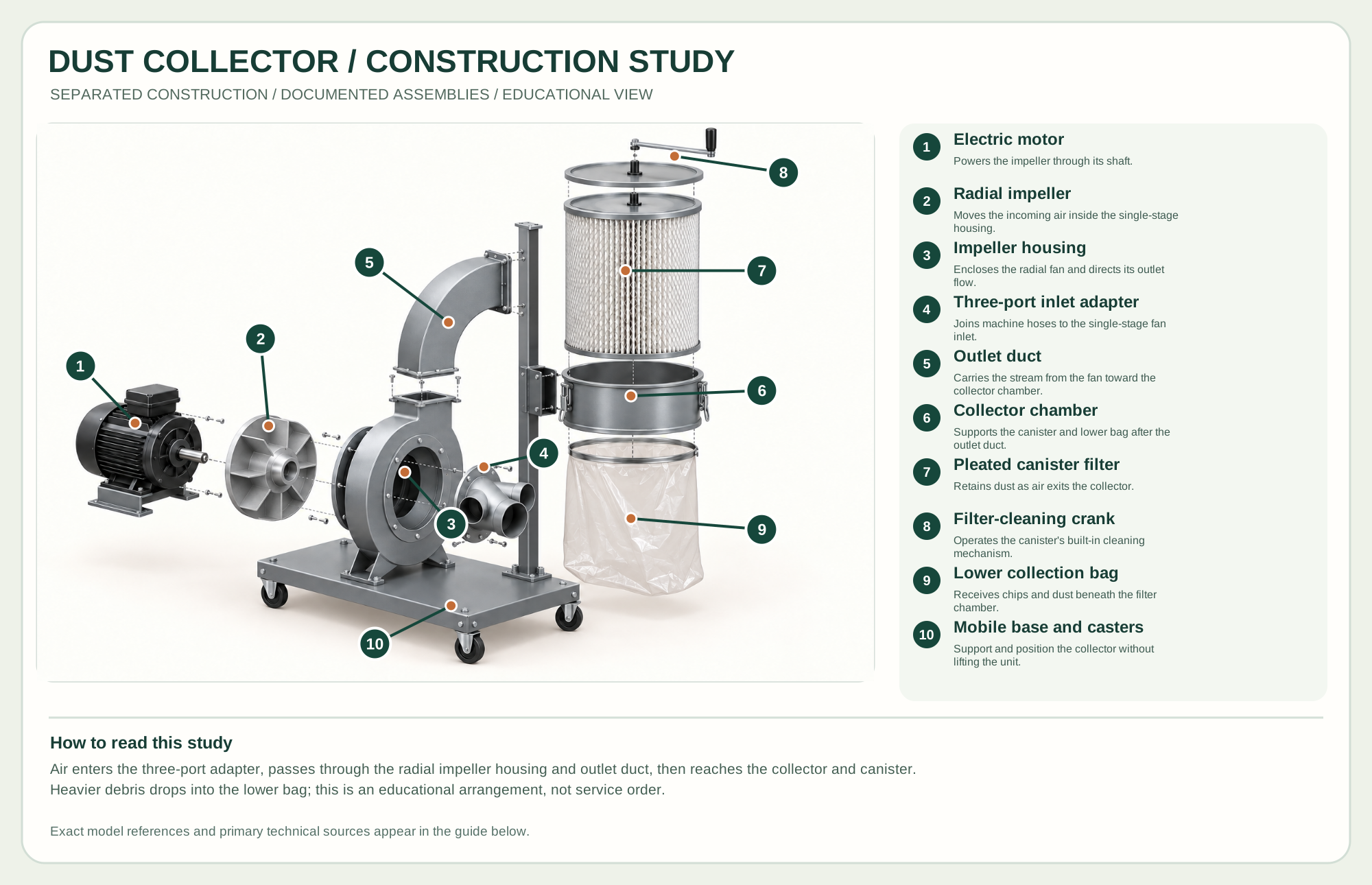
Powers the impeller through its shaft.
Moves the incoming air inside the single-stage housing.
Encloses the radial fan and directs its outlet flow.
Joins machine hoses to the single-stage fan inlet.
Carries the stream from the fan toward the collector chamber.
Supports the canister and lower bag after the outlet duct.
Retains dust as air exits the collector.
Operates the canister's built-in cleaning mechanism.
Receives chips and dust beneath the filter chamber.
Support and position the collector without lifting the unit.
Technical references: Grizzly G0548ZP official product specifications · Grizzly G0548ZP manual and parts diagram. The G0548ZP single-stage reference has a 2 HP motor, radial aluminum impeller, three-port inlet, outlet connector, pleated canister and lower collection bag. These assemblies are visibly separated to show the mechanical and airflow relationship; no cyclone is implied. Original educational artwork depicts documented component groups and their relationships; it is not a service sequence or a replacement for the exact model manual.
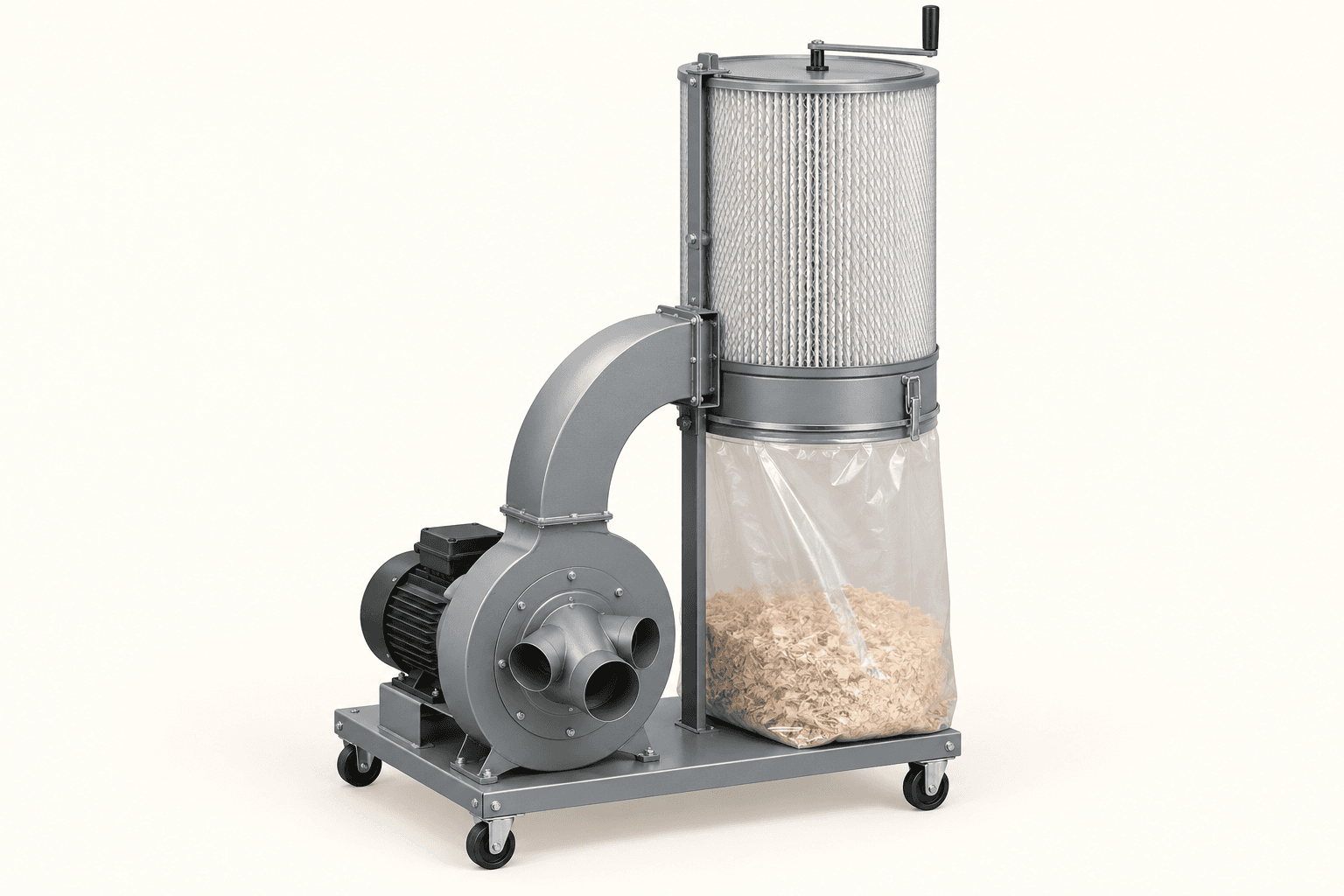
A stationary dust collector moves a large volume of air through hoses or ducts to capture chips at woodworking machines. The illustrated single-stage Grizzly G0548ZP class has a fan, three-port inlet adapter, canister and lower bag; it is not a cyclone. A dust extractor handles small portable-tool ports and higher resistance differently, while an ambient air cleaner treats suspended dust after it escapes. None replaces capture at the source or appropriate personal protection.
The electric motor turns an impeller inside its housing. Air entering the inlet carries chips through the fan and outlet into the collector chamber. Heavier debris falls into the lower bag; air passes through the canister filter before returning to the room. A cyclone is a separate design that separates much debris before it reaches the fan or filter. Real flow at a machine depends on the complete hood, hose, duct, bends and filter condition—not a free-air CFM label alone.
The reference has a 6-inch main inlet with a three 4-inch adapter. Close unused branches and size the duct system for actual machines; adapters do not create additional fan capacity.
The selected reference uses a 2 HP motor and radial impeller inside a closed housing. Do not open that housing while connected to power.
Pleated media supplies surface area to retain fine dust; the model's stated 1-micron rating is manufacturer-specific and does not guarantee zero exposure.
A lower plastic bag collects separated material. Leaks at its rim or filter seal can return fine dust to the shop.
These decisions make the mechanism useful at the bench.
Connect the machine hood so air enters where chips and dust are generated. Keep short, smooth runs where practical.
Empty the bag before it restricts the chamber and clean the canister using the maker's mechanism and schedule.
A collector, duct and hood form one system. Inspect closed blast gates, blocked hose, leaks and loaded filters when capture drops.
Capture heavy chips at large machine hoods with suitable duct diameter.
Connect guards or below-table hoods as designed; one open hose rarely captures all fine dust.
A mobile collector can serve one machine at a time; fixed ducting should be designed for adequate flow at the active branch.
Use the steps for a first pass, then inspect the work before changing the setup.
A cyclone spins chips out before the filter. The illustrated unit sends the stream through its impeller to the bag and canister.
Visible chips are only part of exposure. Filter rating, seals, hood design and residual airborne dust all matter.
Duct resistance and a loaded filter reduce flow. Compare a complete installed system, not bare fan numbers.
The illustrated reference uses a canister and collection bag. Fabric-bag filtration and seal quality vary.
A cyclone pre-separates debris into a bin. Its inlet, cone and bin are not parts of this reference poster.
Portable extractors serve smaller high-resistance ports; ambient cleaners capture suspended air dust after release.
Stop the tool and disconnect power before investigating a fault or changing a part.
Check gate position, hose clogs, bag fill, filter load and loose duct joints.
Stop; inspect bag rim, filter seat, canister damage and housing seals.
Switch off and disconnect; inspect for obstruction and consult the exact manual before restarting.
Use the exact tool manual for setup, limits and replacement parts. These lessons, documents and model pages teach relevant techniques or help compare real variations.
Official assembly, maintenance, electrical and parts information for the selected single-stage collector.
Official replacement parts for the exact reference configuration.
Official motor, impeller, inlet, canister and bag information.
Manufacturer demonstration of bag replacement; check the selected model's manual for its exact bag attachment.
Independent workplace guidance on capturing wood dust at machinery.
These maker-owned links document relevant tools and tool brands. A product brand may use another company's factory; compare the exact model before choosing parts or accessories.
Cutters, abrasives, guards, guides, dust fittings and service parts vary by tool. Check the model plate and manufacturer manual before ordering or changing a component.
Compare the Dust Collection & Air Filtration family →Continue through the Tools library