
Iron body and sole
The ductile-iron casting supplies a flat reference surface, continuous cheeks and a mouth opening; keep rust off the ground sole.
Prepare a final surface with a thin shaving, a sharp iron and a flat sole that follows the work.
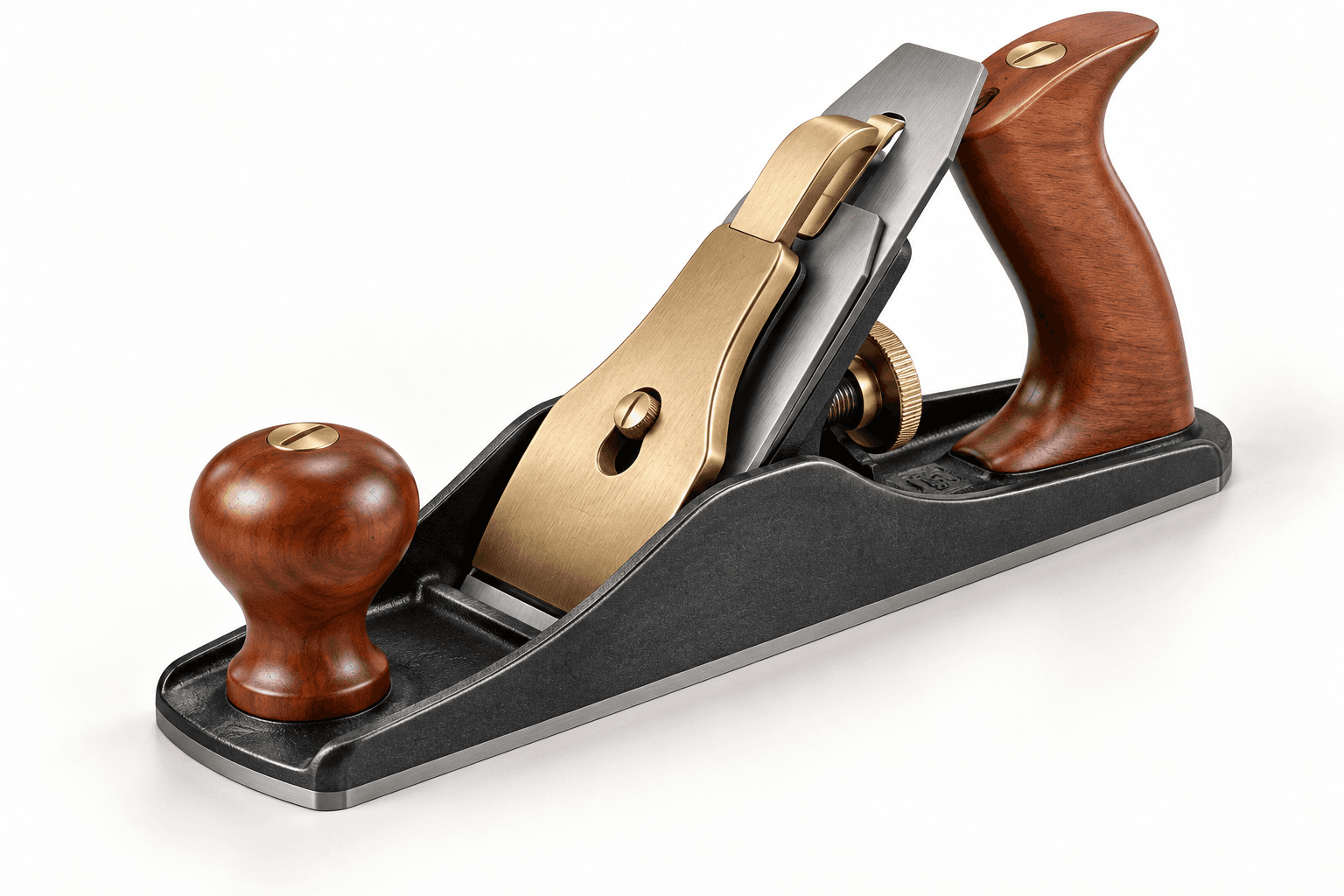
An original educational poster identifies 8 documented construction features. The numbered descriptions remain readable below the artwork on narrow screens.
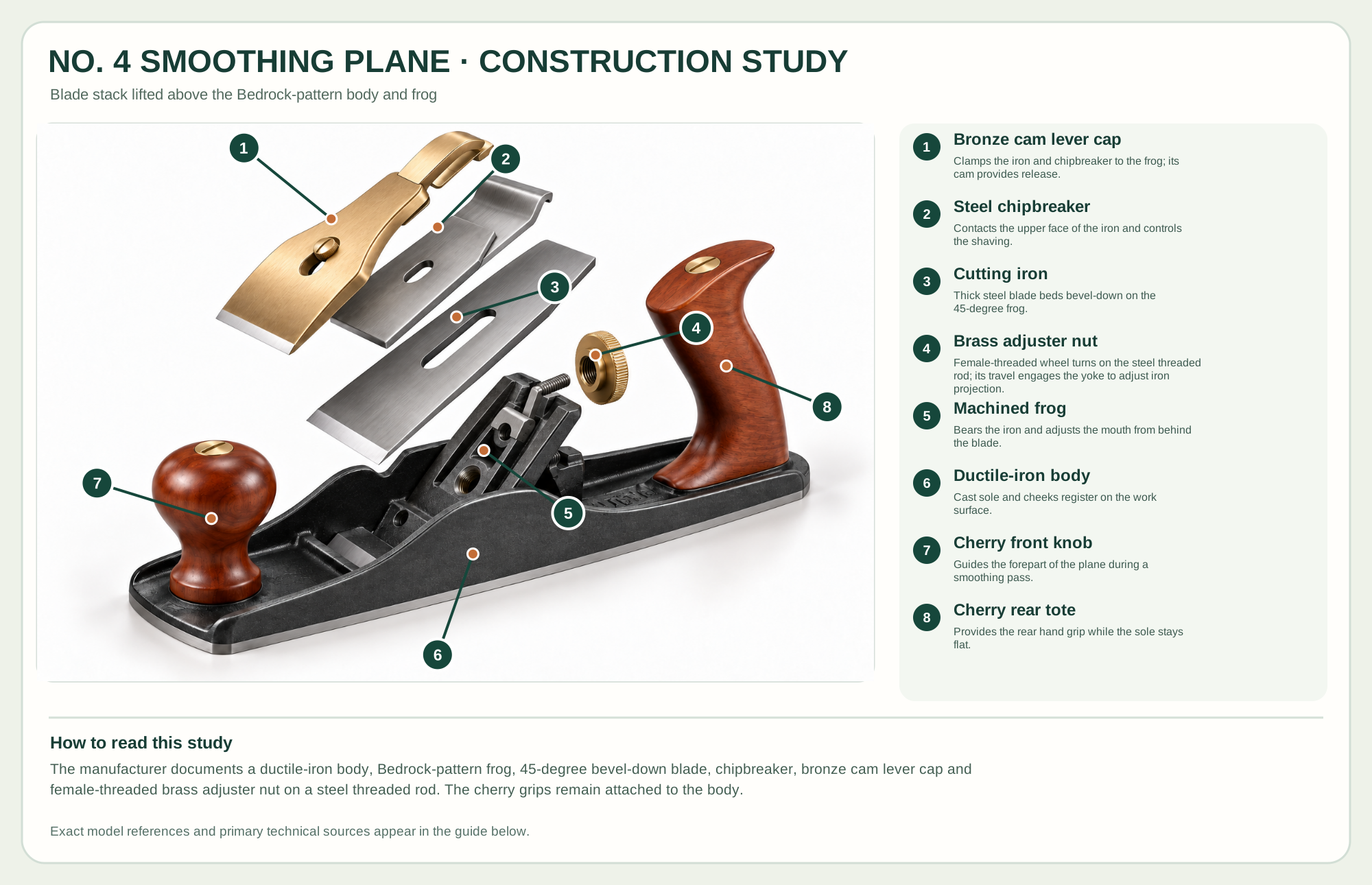
Clamps the iron and chipbreaker to the frog; its cam provides release.
Contacts the upper face of the iron and controls the shaving.
Thick steel blade beds bevel-down on the 45-degree frog.
Female-threaded wheel turns on the steel threaded rod; its travel engages the yoke to adjust iron projection.
Bears the iron and adjusts the mouth from behind the blade.
Cast sole and cheeks register on the work surface.
Guides the forepart of the plane during a smoothing pass.
Provides the rear hand grip while the sole stays flat.
Technical references: Lie-Nielsen No. 4 iron smooth plane · Lie-Nielsen official Bench Planes instructions. The cap, chipbreaker and cutting iron separate from the frog and cast body. The female-threaded brass adjuster nut is shown clear of the fixed threaded rod and yoke to reveal its location; the frog remains seated. This is an educational arrangement, not an exact service sequence. Original educational artwork depicts documented component groups and their relationships; it is not a service sequence or a replacement for the exact model manual.
The Lie-Nielsen 1-4I is a standard-size iron-body No. 4 smoother, 9½ inches long with a 2-inch, ⅛-inch-thick A2 iron. Its blade beds bevel down at 45 degrees on a Bedrock-pattern frog. A No. 4 follows modest local contours for fine finishing; a longer jointer registers over a wider span. The illustrated finish omits markings while retaining the documented cherry grips, bronze cap and brass adjuster.
The sole registers against the wood while the exposed edge shears a thin shaving through the mouth. The chipbreaker contacts the blade, the bronze cam lever cap clamps the stack against the frog, and a female-threaded brass adjuster nut travels on a steel threaded rod to work the yoke and change iron projection. Loosening two frog locks and turning the rear adjuster changes the mouth on this design. The separated image is educational; its nut and blade stack are spaced to show relationships, not a required service sequence.
The ductile-iron casting supplies a flat reference surface, continuous cheeks and a mouth opening; keep rust off the ground sole.
The machined frog supports the 45-degree bevel-down iron and can shift to alter mouth opening after its locks are loosened.
The thick A2 iron takes the edge; the chipbreaker meets its upper surface to control the shaving. Set the chipbreaker close for fine smoothing without clogging.
A bronze cam cap secures the blade stack, a brass wheel adjusts projection and cherry tote and knob guide the plane.
These decisions make the mechanism useful at the bench.
Hone the iron and remove its burr. A sharp edge matters more than a very tight mouth on most stock.
Seat the chipbreaker and cap, advance the iron cautiously, check lateral projection and test on scrap.
Support the board, track grain direction and take overlapping strokes that keep the sole level.
Remove machine marks and shallow tear-out in thin, controlled passes.
Refine a small amount from a mating surface while checking square and fit.
A sharp iron, close chipbreaker and light cut can reduce tear-out; test each difficult board.
Use the steps for a first pass, then inspect the work before changing the setup.
A sharp iron will still follow errors if the sole rocks; register it flat and avoid tipping at board ends.
The cap clamps the pair; the chipbreaker controls chip flow. Their contact surfaces should be clean and firmly mated.
The Bedrock-pattern frog shifts a real mouth setting; it is not a replaceable throat plate on this reference model.
Iron and bronze smoothers differ in mass and corrosion behavior; this reference is the ductile-iron 1-4I.
Optional high-angle frogs exist, but the standard illustrated 1-4I beds its bevel-down iron at 45 degrees.
Shorter smoothers follow local surface shape; longer bench planes straighten over greater distances.
Secure the work, protect sharp edges and release any stored clamping pressure before adjustment or maintenance.
Check sharpness, grain direction, chipbreaker contact, cut depth and mouth setting on scrap.
Clean the mouth and check the chipbreaker fit and cap tension; avoid forcing a clogged pass.
Check lateral blade setting, straightness of the sole and whether the board is firmly supported.
Use the exact model documentation for setup, limits and replacement parts. These lessons, documents and model pages teach relevant techniques or help compare real variations.
These maker-owned links document relevant tools and tool brands. A product brand may use another company's factory; compare the exact model before choosing parts or accessories.
Handles, irons, saw plates, clamping pads and other replacements vary by maker and model. Use the maker's documentation before changing a component.
Compare the Hand Planes family →Continue through the Tools library